PCPPrivate Credit Prep
Private Credit Prep · Interview memo
To
Candidates with a private credit, direct lending or private debt interview
From
A private credit analyst, direct lending deal team (anonymous)
Re
Answering a private credit interview like the lender across the table
cc
Subscribers at London Business School, HEC Paris, UC Berkeley and eight other schools

Private credit interview preparation, written from the lender's side.

A credit interview asks one question in many forms: would you lend to this business, and on what terms? The Interview Guide answers eighty of them the way a lender would, in the order the interview runs, with threecases and ten cheat sheets.

Refund if a file is defective or not as described. Or start free: a 17-page sample or the credit memo template.

Subscribers include students at

Private Credit PrepPage 1 of 6
Section A · What the interview tests

Built for interviews at

Three distinctions interviewers listen for

A good business is not always a good credit.

The test is what cash flow and debt service look like in the downside case. Growth matters only as far as it survives that case.

Documentation moves value before the numbers do.

Leakage, permissive baskets and loose covenants can shift value away from the lender long before a ratio looks broken.

A wider spread is compensation, and it has to be earned.

Extra coupon helps only if coverage still holds and the borrower can refinance from a position of strength.

Exhibit 1Mean interest coverage, EBITDA / interest
Private credit borrowers2.0x
Leveraged loan borrowers2.7x

Source: Federal Reserve, FEDS Notes, Feb 2024

Exhibit 2Post-default value, % of face
Direct loans33%
High-yield bonds39%
Syndicated loans52%

Source: Federal Reserve, FEDS Notes, Feb 2024

How the private credit interview is structured
Private Credit PrepPage 2 of 6
Section B · One question, reviewed

Try a question, exactly as the guide prints it

Scroll through it: the usual candidate answer is struck out and the lender's answer goes in, with the reviewer's notes in the margin. Every one of the 80 questions carries why it is asked, the answer and the common mistake.

From the guide

Question 62 of 80 · 07 · Underwriting & Downside · P0 must know cold

Would you lend to this business?

Candidate's draft, illustrative

Deleted: It's a strong business with good growth and solid margins, so broadly yes, but I'd want to do more work on the numbers before taking a firm view.

The lender's answer, as printed in the guide

Yes, but only at moderate leverage. The reasons would be resilient demand, decent cash conversion, and a structure that still leaves room in downside. The first thing I would test harder is the main pressure point, for example customer concentration, margin volatility, or working-capital risk. A strong credit answer takes the view early, then explains the conditions under which that view still holds.

Memory hook: Decision first, reasons second, condition third.

Private Credit PrepPage 3 of 6
Section C · The Interview Guide

Four PDFs, 129 pages, for the week before the interview

The guide runs in the order of a real interview: fit, statements, cash generation, LBO logic, debt products, documentation, downside, case work, market overlay. Open any line for its objective and the questions to know cold.

01Story, Fit & Motivation10 q. · p. 4

Start like a real candidate, not a CV recital. Sound intentional, specific and already oriented toward credit before the technicals start.

  • Tell me about yourself
  • Why private credit?
  • Why leveraged finance, debt advisory or private debt?
  • Why this firm and team?
  • Tell me about a deal you worked on
02Accounting & 3 Statements12 q. · p. 14

The basic mechanics still eliminate candidates. Show you understand how cash moves through the statements, not just the vocabulary.

  • Walk me through a P&L
  • Walk me through a cash flow statement
  • How do the three statements link together?
  • What does higher D&A do to the three statements?
03Cash Flow, Working Capital, FCF & Ratios10 q. · p. 25

Lenders are paid in cash, not in EBITDA. Explain where cash gets trapped and what that does to repayment capacity.

  • Why is an increase in working capital a use of cash?
  • Give me an example of negative working capital
  • What is FCFF and how do you calculate it?
  • Walk me through free cash flow
04LBO Logic & Valuation10 q. · p. 34

Know the LBO, answer it like a lender. Connect leverage, cash generation and downside: can the structure survive and repay?

  • Walk me through an LBO
  • What makes a good LBO candidate?
  • What are the value creation levers?
  • How do you structure an LBO transaction?
05Debt Instruments & Pricing10 q. · p. 45

Where private credit stops sounding generic. Rank the stack, explain why each layer exists and connect yield to risk.

  • Bullet vs PIK: a simple example
  • What is a unitranche?
  • Why a unitranche rather than senior plus mezzanine?
  • Pricing and maturity of each tranche
06Documentation & Lender Protection8 q. · p. 56

Monitor the risk before the payment default. Show how a lender keeps control after closing and sees trouble early.

  • How do covenants protect a lender?
  • Maintenance vs incurrence covenants
  • What does a lender watch after closing?
07Underwriting & Downside8 q. · p. 63

Take a view. Defend it. Protect the downside. Take a lending view early and justify it with what breaks first.

  • What do you look at when analyzing a debt file?
  • Would you lend to this business?
  • What are the main risks in a credit?
  • How do you stress-test a credit?
08Case Studies & Deliverables8 q. · p. 70

The formats candidates are asked to produce. Synthesize into a recommendation, in the format a credit team reads.

  • What goes into a one-pager?
  • What goes into a lender-facing debt IM?
  • What goes into a credit memo?
  • Your first 10 minutes in a timed case
09Market Pulse & Team Overlay4 q. · p. 77

Short, current and team-specific. Sound current without a market lecture, and tie it back to underwriting.

  • What do you know about our team, positioning and recent deals?

Nine sections, in interview order80 questions · 86 pages

Private Credit PrepPage 4 of 6
Appendix A · Sources and recent analysis
Private Credit PrepPage 5 of 6
Section D · Terms

Everything a lender will ask, in the order they ask it

Summary of termsPrivate Credit Prep
Product
Private Credit Interview Guide
Price
$197 one payment, no subscription
Contents
Interview guide (86 pp.), case studies (15 pp.), answer key (16 pp.), cheat sheets (12 pp.), credit memo template
Format
Four printable PDFs, yours to keep
Delivery
Instant download after checkout, through Gumroad
Refunds
Refund if a file is defective or not as described. Report it within 14 days with your order number and what is wrong. The file is replaced within 5 business days, or the order is refunded.
Support
support@privatecreditprep.com

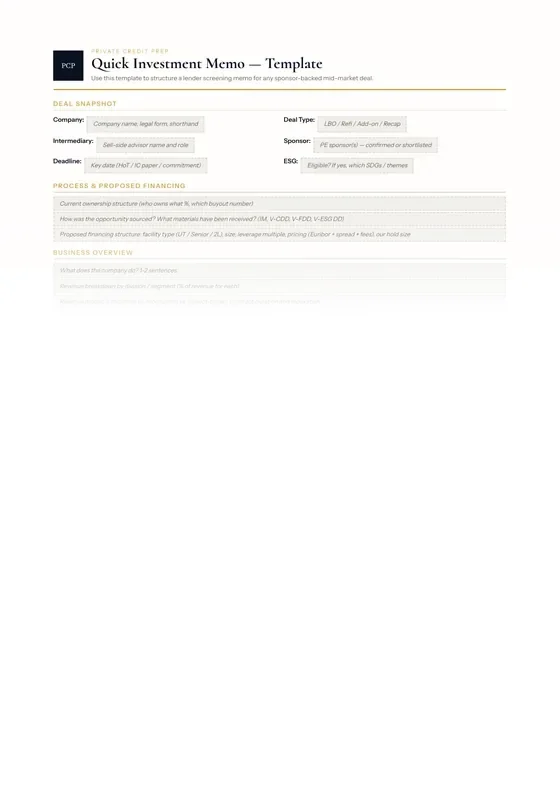
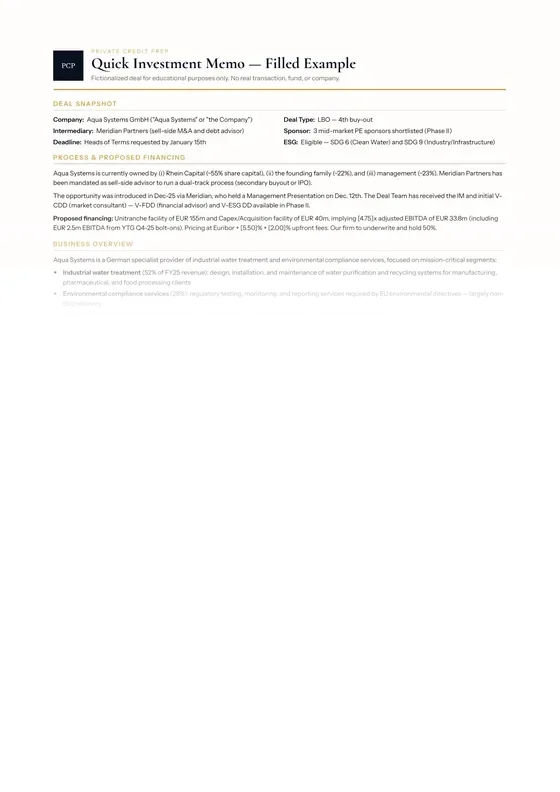
Free enclosure: the credit memo template

The structure a lender uses to write up a credit, blank and filled in on a fictional buyout. Two Word files, sent to your inbox.

Questions before buying

  1. YOUWho is this for?

    PCP
    Candidates interviewing for private credit, direct lending, special situations or private debt roles, from analyst to associate.
  2. YOUHow long does it take to go through?

    PCP
    A first pass takes a few hours. With one day, the guide tells you to read sections 1 to 5 first; with two, add 6 and 7.
  3. YOUIs this a generic finance course?

    PCP
    No. It covers what a lender asks and why: downside, structure, documentation and recovery. Accounting is covered only as far as a credit interview tests it.
  4. YOUHow do I get access?

    PCP
    The four PDFs download immediately after checkout, through Gumroad. No account, no subscription.
  5. YOUIs this a subscription?

    PCP
    No. One payment of $197, and the files are yours to keep.
  6. YOUCan my employer pay for it?

    PCP
    Often, yes. The expense page has a short note you can send to your manager.

Anything else: support@privatecreditprep.com

Private Credit PrepPage 6 of 6