Xerox: Paying Rent to Be Xerox
From 2027, Xerox pays at least $104.5mm a year to rent its own name; the loan behind it needs at least $72.0mm. On October 29, bondholders who promised not to sue were offered about 59 cents; the rest closed at 30.
Private Credit Prep desk5 November 202617 min read28 sources, listed at the end
On October 29, 2026, Xerox offered some of its bondholders $750 in new first-lien notes and stock for every $1,000 of its 5.5% notes due 2028, the same notes Xerox had been buying back in the first quarter at roughly 45 cents on the dollar [1][2][3]. Only holders who had signed a promise not to challenge the financing Xerox arranged in February were invited. At that evening's closing prices, we estimate the package was worth about 59 cents, while identical notes in everyone else's hands last traded at 30 [4][5][6].
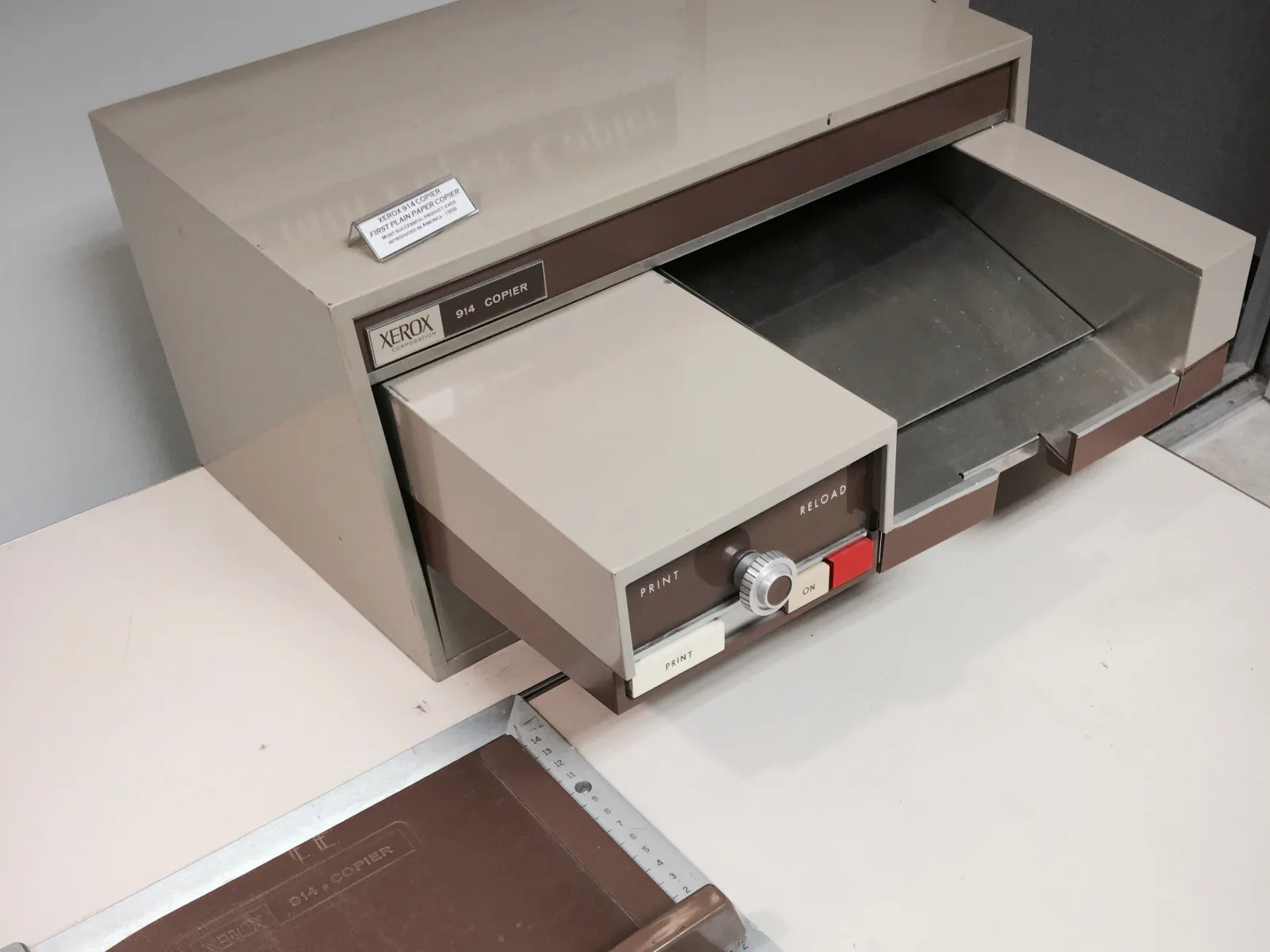
Why would a company that now expects $50mm to $100mm of free cash flow for 2026 pay a premium for silence, and why would its creditors sell theirs? Both answers trace back to a copier. The Xerox 914, unveiled in 1959, made the company's name a verb, and sixty-seven years later the word is worth more than the company behind it [7][8]. Xerox moved the name into a separate company in February 2026, and that company raised $450mm against the brand from investors led by funds managed by Angelo Gordon, part of TPG. Xerox has paid rent to use its own name ever since [9][10]. By the close on October 29, the stock market valued all of Xerox at roughly $220mm, about half of what those investors had put up for the name and the rest of the intellectual property [11][6].
This write-up starts with what Xerox sells and what its name is worth, then traces Xerox's sale of the name to a company Xerox still consolidates. From there, we'll break down the rent and TPG's debt, before turning to the October 29 exchange and a lender's reading of the whole structure. We will also look ahead, as Xerox expects the exchange to settle around November 13, and the license faces a first full-year revenue test on December 31 [1][10].
The Name
By the mid-1960s, an office that wanted a Xerox 914 could buy one outright or rent it for twenty-five dollars a month, plus at least forty-nine dollars' worth of copies at four cents each [8]. Xerox set those prices "to make renting more attractive than buying, because Xerox ultimately makes more money that way," The New Yorker reported in 1967. The machine was beige, weighed six hundred and fifty pounds and looked "a good deal like a modern L-shaped metal desk" (its name came from the 9-by-14-inch sheets it could copy), and by 1965 it accounted for about 62% of Xerox's operating revenues [7][8].
Haloid, "a small photo-paper maker in Rochester, N.Y.," had adopted "XeroX" as a trademark several years before taking the word as its own name, a spelling The New Yorker called "a shameless imitation of Eastman's 'Kodak'" [7][8]. The company became Haloid Xerox in 1958 and, in 1961, "went the whole hog and changed its name to plain Xerox Corporation," so the name on its machines was older than the company that carried it [8].
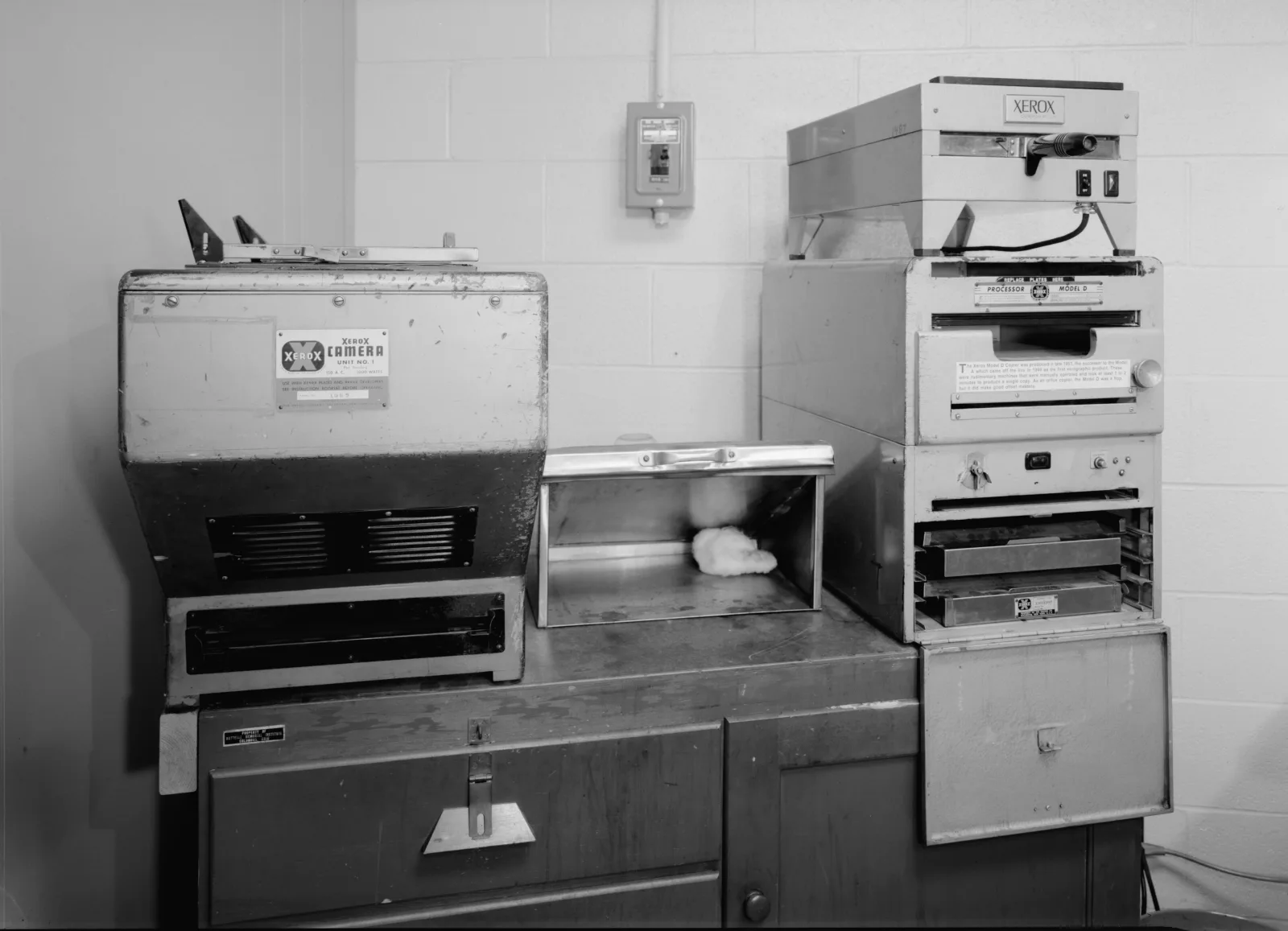
Once the first 914 shipped to a customer in March 1960, the word didn't stay a trademark for long. Merriam-Webster dates the verb's first known use to 1965, and by 1967 "to xerox" appeared so often "in conversation and in print that the company's proprietary rights in the name were threatened" [7][12][8]. Xerox spent decades running advertisements against its own success, including one from 2003 that read, "When you use 'Xerox' the way you use 'aspirin,' we get a headache." Barbara Basney, its vice president of global advertising, told the AP in 2012 that "in the mid- to late-1970s, we ran dangerously close to Xerox becoming 'genericized'" [13].
Xerox's annual report for 2007 said it owned approximately 550 U.S. trademarks and that "we vigorously enforce and protect our trademarks" [14]. The report for 2025, filed in March 2026, listed 159, repeated that sentence word for word, and then added that Xerox had contributed "the trademarks in respect of the Xerox brand" to a joint venture [15].
Xerox now sells office and production printers, IT solutions and financing for the equipment it places, and it expects roughly $7.6bn of revenue in 2026 [11][16]. However, not all of that carries its name. Lexmark, a printer maker Xerox bought in July 2025, still sells under its own brand and brought in roughly $1.03bn in the first half of 2025, so we estimate that roughly $5.6bn, about three-quarters of Xerox's revenue, is sold under the Xerox name [17][15]. When an office buys a Xerox-branded printer in 2027, 2% of what Xerox books on that sale will be owed to XRX Brandco LLC, a Delaware company that now owns the name on its front. Every Lexmark product moved under what Xerox calls "the unified Xerox brand" adds to that bill [10][11].
Think of Xerox's name as a building the company has always worked out of. Until February, Xerox owned it outright, and since then it has been a tenant, with a lease, a landlord, a landlord's lender and a rent that rises with every product it moves in. In 1965, customers paid Xerox rent for its machines; in 2026, Xerox pays rent for the word printed on them.
Equity value is the closing share price times 132.694mm shares outstanding at September 30, 2026. Sources: Xerox 8-K, February 17, 2026 [9]; Q3 2026 results [11]; Nasdaq [6]. PCP calculation.
How Xerox Sold Its Name to Itself
On February 17, 2026, Xerox contributed its intellectual property, "including the trademarks in respect of the Xerox brand," to XRX Brandco Holdings LLC and its subsidiary XRX Brandco LLC, which we'll call IPCo [9]. IPCo borrowed $405mm from lenders led by funds managed by Angelo Gordon, sold $45mm of Class A preferred units to those funds "and certain other investors," and sent all $450mm up to Xerox [9]. Xerox kept a majority of IPCo's common units and consolidates it, so the name never left Xerox's consolidated accounts, where that $450mm now sits as debt [18][16]. Fees came to $54mm, roughly 12% of what was raised [16].
XRX Brandco Holdings LLC and XRX Brandco LLC (IPCo)
Own the Xerox name; may not hold other material assets, run a business or borrow more [10][18]
Lenders led by Angelo Gordon (TPG): $405mm term loan
3.00% SOFR floor, due February 2031, secured by substantially all of IPCo's assets [9]
Xerox, as licensee
Needs IPCo's license to use the Xerox name, its own corporate name included, until at least 2036 [10]
Sources: Xerox 8-K [9], license [10] and IPCo credit agreement [18], February 17, 2026; Q2 10-Q [16].
The contract, the Shared Services and License Agreement, reads like a commercial lease drafted by the landlord. Xerox received "a worldwide, royalty-bearing, non-exclusive, non-transferable, and non-sublicensable" license to its marks, including "as part of its corporate name," meaning Xerox Corporation needs a license to use its own legal name [10]. IPCo was given "ultimate control over the nature and quality" of licensed products and a right to inspect Xerox's sites. Xerox must develop those products "on the maximum possible scale," may not abandon any trademark containing "XEROX," and cannot assign the agreement without IPCo's consent, which IPCo may withhold "in its sole discretion" [10]. The 8-K that announced the deal described the license as "royalty-free," although only the shared-services license was free, and the trademark license carried the royalty [9][10].
“All right, title and interest in and to the Licensed Marks, including all goodwill associated with the use of the Licensed Marks, shall remain vested in and inure to the benefit of IPCo.”
Of nine events that let IPCo terminate, one is worth flagging now because it comes back in October. If any Xerox licensee asserts in writing that a material provision is not "a legal, valid and binding obligation," IPCo gains a right to end the license. As a result, Xerox cannot challenge its own lease without handing its landlord grounds to evict it [10].
In August 2020, Xerox issued its 2028 notes under an indenture whose covenants covered liens, a change of control and the designation of unrestricted subsidiaries. There was no limit on restricted payments, general investments or asset sales, a package closer to what investment-grade issuers get [19]. The first-lien notes Xerox sold in April 2025 to help pay for Lexmark did carry a J.Crew blocker. However, it only barred moving material intellectual property into an "Unrestricted Subsidiary," and designating one needed consent from 100% of holders, which shut the classic J.Crew route [20][15].
Xerox took a different route, through that indenture's definition of "Subsidiary," which covers an entity only if Xerox owns or controls more than 50% of its voting power [20]. Owning most of IPCo's common units does not settle that question, since Xerox's filings say IPCo's equity holders "lack substantive decision-making rights" [16]. The definition leaves out a joint venture whose votes sit with outside investors, so the blocker never reaches it. Winston Taylor wrote in March that because Xerox's IP went to "a non-subsidiary joint venture, any J. Crew (or other 'crown jewel') protections did not apply" [21]. Xerox has not filed the LLC agreement that sets the voting split, so we cannot confirm it. Still, Octus reported in February that the company "is believed to have used the split ownership structure in the transaction," and October's documents treat IPCo separately from Xerox's subsidiaries throughout [22][23].
The Rent
Xerox pays IPCo 2.0% of what their agreement calls "Specified Revenue" every quarter, and that definition is narrower than Xerox's top line [10]. It covers GAAP revenue on goods and services "bearing any of, sold under, or provided under" Xerox's marks, so Lexmark's sales stay out for as long as they carry Lexmark's name. Even inventory that ABL lenders seize and sell counts toward it [10]. This rent never shows up in Xerox's income statement, since IPCo is consolidated and its royalty is eliminated [16].
Starting with the twelve months to December 31, 2026, Specified Revenue must also stay at or above $5,225mm, and a miss doesn't get the 30-day cure period that other breaches do [10]. At a 2% royalty, that floor means IPCo collects at least $104.5mm a year from 2027 for as long as Xerox complies. On our estimate of branded revenue, the rent should run between $105mm and $120mm [10][17].
Every dollar of rent lands in IPCo's reserve account, and the credit agreement limits withdrawals to a short list of uses, nearly all of which pay the lenders and the Class A holders [18]. In practice, cash covers interest and Class A distributions first, then 4.5% annual amortization, then overhead and up to $20mm of reserve. Whatever is left each quarter is swept, all of it, into prepaying the loan and Class A units pro rata [18][9]. Xerox gets nothing back from its own name until TPG and its co-investors are repaid, apart from a one-time distribution that can return a small contribution it made in the spring [18]. So how much of that rent does TPG actually need?
At the 3.00% SOFR floor, interest on the $405mm loan at S + 812.5 comes to $45.1mm a year, distributions on $45mm of Class A units at S + 1,187.5 to $6.7mm, and amortization to $20.3mm [18][9]. The minimum rent of $104.5mm therefore covers $72.0mm of debt service about 1.45x, and a little less with SOFR above its floor, as it was at the end of July [24]. Either way, that coverage is struck on revenue instead of profit, it comes out of Xerox's sales before Xerox's own creditors are paid, and every dollar of excess goes to TPG.
Annual figures. Debt service is interest on the $405mm loan, distributions on the $45mm of Class A units and 4.5% amortization. Rent is 2.0% of revenue sold under the Xerox name. PCP illustrative calculation from the license [10], the credit agreement [18], the 8-K [9], Lexmark's accounts [17] and term SOFR [24]; not company guidance.
From 2027, at least $104.5mm a year of Xerox's sales will flow into an account that pays little besides IPCo's financiers, which is more than the $50mm to $100mm of free cash flow Xerox now expects for all of 2026 [18][11]. Those two figures don't stack, since the royalty cancels out of consolidated accounts and only what IPCo pays TPG and its co-investors leaves the group. Still, the comparison shows how much of Xerox's cash is spoken for before anyone else sees it [16].
Xerox's minimum rent works out to roughly 25.9% a year of the $404mm it netted at closing. This is not an interest rate, since Xerox keeps its common units and, in theory, whatever IPCo is worth once TPG is repaid [16]. On our simplified model, a full sweep would bring TPG's $405mm loan down to roughly $90mm to $150mm by February 2031, meaning a tenant ends up paying off most of its landlord's mortgage [18]. However, nothing in the license hands Xerox its name back when that happens. It runs ten years, to February 2036, extends by five years unless either side objects, and leaves the marks with IPCo, whose operating agreement, where any route back to Xerox would sit, was never filed [10][16].
The Price of Peace
On October 29, Xerox signed an exchange support agreement with holders of $173.7mm of its 2028 notes, about 31.1% of those outstanding [1][2]. Each signer was offered, per $1,000 of notes, $690 of new 10.25% first-lien notes due October 2030 plus 25.316456 shares, with the new notes coming from Xerox Corporation, the operating company, and sharing the collateral of its existing first-lien notes [2]. Xerox valued those shares at $60, "based on a discount to the pre-announcement VWAP," which implies $2.37 a share, and only signers could take part, all of whom "have agreed to participate" [25][2].
Xerox's press release said the exchange was "anchored by an ad hoc group of first lien lenders," advised by Moelis and Gibson Dunn. In February, Octus had reported that those two firms were advising a group of Xerox lenders on a cooperation agreement after the IPCo deal [25][22]. Xerox's S-3, filed a day later, named the holders taking stock, among them Rokos, Millennium, Whitebox, HG Vora, Algebris, Silver Point and a fund managed by Blackstone Alternative Solutions [26].
In return, each signer "irrevocably covenants and agrees" not to bring or support any action against Xerox, IPCo or their agents "arising out of, relating to or in connection with the IPCo Transactions" [2]. The new indenture defines that term broadly enough to include any future "foreclosure or other transfer of assets (including Intellectual Property)" under IPCo's documents, so holders have agreed in advance not to fight TPG if it ever takes Xerox's name outside a bankruptcy [2]. Nothing in the filings shows anyone had sued, so the promise waived claims that holders might have brought later.
This is where February's written-challenge clause comes back. Xerox could not contest IPCo's financing itself, since a written claim that its license was not binding would give IPCo a right to terminate it. The attack was left to its creditors, and on October 29 Xerox paid some of the best organized among them to stand down [10][2]. However, their promise ends where it would matter most.
“The foregoing covenant … shall terminate upon the commencement of any proceeding by any of the foregoing entities or their Affiliates under any Debtor Relief Law.”
This covenant also falls away if the exchange doesn't close, and it terminates whether a proceeding starts "voluntarily or involuntarily." The signers have kept every argument about February for a bankruptcy court, the one forum where those arguments would decide recoveries [2].
Once the exchange settles, the signers move from an unsecured note at Xerox Holdings, due August 2028, to a first-lien note at the operating company, due October 2030, ahead of $382.5mm of notes left outside [2][25]. They also got a new covenant in the term loan and both first-lien indentures. Under it, IPCo's debt is capped at what it owes TPG, that cap falls with every repayment, IPCo may not issue new units or grant another license over its assets, and signing lenders get five business days to take up any refinancing of TPG's debt on the same terms [23][2]. Until February 2029, any such refinancing cannot cost more than TPG's loan, and a default at IPCo cannot trip the new notes, whose cross-default clause excludes any acceleration "as a result of the IPCo Transactions" [23][2].
By the close on October 29, the market had split the 2028 class in two. Notes left outside opened at 45.16 and last traded at 30.0, while signers' packages, priced at closing levels for existing first-lien notes and Xerox stock, came to roughly $591 per $1,000 [4][5][6]. Xerox's stock fell 40.3% to $1.665 that day, as it also cut its free cash flow guidance, booked a $959mm goodwill impairment and suspended dividends [6][11]. Octus's other creditor group from February, second-lien and unsecured holders advised by Paul Hastings, does not appear anywhere in October's documents [22].
Value per $1,000 of 5.5% notes due 2028. The package at closing prices is $690 of first-lien notes at 79.5 plus 25.316456 shares at $1.665. Bond prices are last TRACE trades on thin volume. Sources: Q1 10-Q [3]; exchange documents [2][25]; TRACE via TradingView [4][5]; Nasdaq [6]. PCP calculation.
The exchange, Xerox says, cuts debt by approximately $53mm and moves $121mm of maturities from 2028 to 2030, and the company expects it "to keep cash interest approximately neutral" [25]. On the exchanged notes alone, we estimate annual cash interest rises from roughly $9.6mm to $12.4mm, and Xerox has not published how it reached its own figure [25][2].
Read clause by clause, nobody bought peace on October 29, since the promise lapses the day Xerox files: the signers bought a place in line ahead of the $382.5mm of notes left outside at 30 cents, with the first call on refinancing TPG in 2031, and Xerox bought two more years on $121mm of its debt [2][23][4].
How a Lender Reads It
TPG's funds lent against a rent that covers their debt service about 1.45x at its floor, with a sweep that should retire most of their principal before the loan matures in February 2031 [18]. An early refinancing would also cost a prepayment premium, still 3.875% in the loan's second year [18]. If the license ends after a Xerox default, or if Xerox rejects it in an insolvency, Xerox owes liquidated damages equal to an "Expected Royalty Fee Value," which the parties called "a reasonable estimate, as of the Effective Date, of the expected present value of the Royalty Fees for the then-remaining Term" [10]. The schedule that sets that value was never filed, but on our own rough assumptions, ten years of rent discounted at 12% would exceed everything IPCo owes.
Those damages are guaranteed and secured by assets of certain Xerox subsidiaries, which must also keep an asset coverage ratio against TPG's loan and Class A units every quarter [9][16]. The guarantee was never filed either, so Xerox's other creditors cannot see which subsidiaries stand behind TPG or which assets are pledged. This is the first question we'd ask before buying any Xerox paper.
Under IPCo's credit agreement, whose definition the license borrows, a "Parent Change of Control" includes the case where, after a bankruptcy filing, Xerox's creditors acquire "on account of or in exchange for Indebtedness" more than 50% of Xerox Holdings' equity [18][10]. Any change of control lets IPCo terminate the license and claim liquidated damages. As a result, the usual ending of a restructuring, where creditors swap their debt for the company, would hand TPG a right to take the name away from the business those creditors had just received [10]. Xerox's license turns its brand into a lock on any restructuring, and any group that wants to own Xerox after a chapter 11 will need to settle with TPG first.
Would that lock hold up in a bankruptcy court? In chapter 11, a clause that ends a contract merely because the debtor filed is generally unenforceable under section 365(e)(1) of the Bankruptcy Code, which would let Xerox keep its license as long as it performs [10]. Section 3.12 of the license anticipates that fight, stating that "nothing in this Agreement constitutes consent to any assumption or assignment within the meaning of section 365(c) or section 365(e)." Its wording sets up an argument, accepted in some jurisdictions for licenses that cannot be assigned, that Xerox may not assume the license without IPCo's consent [10]. How a court would rule is open, so we'd treat the clause as negotiating leverage for TPG and not a sure path to the name. Outside Xerox, it's also hard to see who else would rent that name at anything like $104.5mm a year.
Xerox's signing bondholders waived any challenge to TPG outside a bankruptcy and agreed that a default at IPCo won't accelerate their new notes. This leaves them two moments where the documents still give them a say: a chapter 11, where their promise lapses and TPG's lock forces a negotiation, and a refinancing of TPG's loan, where they hold the first offer [2][23]. The holders of the $382.5mm left outside have neither, only an unsecured claim on the holding company that comes due in August 2028 [2][19].
Xerox has a fair defense, since its IPCo financing brought in $450mm in February without needing consent under any of its bond indentures, as we read them, when its unsecured 2028 notes were trading in the 40s [9][4]. Holders of those notes had bought them with no covenant against this kind of transfer, and first-lien holders had accepted a J.Crew blocker that did not reach joint ventures [19][20]. Louie Pastor, who signed the license as Xerox's president and chief operating officer and became chief executive six weeks later, called the financing the completion of "the liquidity-enhancing actions we began in the fall" [10][27][28].
The first test comes on December 31, when the $5,225mm floor applies to a full twelve months of branded revenue for the first time, at a company whose third-quarter revenue fell 4.7% [10][11]. The second comes in February 2031, when what's left of TPG's loan has to be repaid or refinanced and the signers hold the first offer on it [18][23]. Xerox preferred renting its machines to selling them in the 1960s because it "ultimately makes more money that way." Six decades later, Xerox is the one paying rent, and the arithmetic favors the landlord's lender [8].
In an Interview
Interviewers often ask you to walk them through a deal you've been following. Our five-part deal walkthrough works well here: the business, the deal, why you'd lend, the risks with what mitigates each one, and your view. Here's TPG's loan to Xerox's brand company, the way you'd say it out loud.
The business, and how it makes money. Sure. One I've been following is Xerox. It sells printers, IT solutions and equipment financing, about 7.6 billion dollars of revenue this year, and roughly three-quarters of that is sold under the Xerox name [11]. In February, Xerox moved the name into a separate company, which I'll call IPCo, and now pays IPCo a royalty to use its own brand.
The deal: who lent, how much, why now. IPCo borrowed 405 million dollars from funds run by Angelo Gordon, part of TPG, at SOFR plus 812 and a half, plus 45 million of preferred units, and passed it all up to Xerox [9]. Xerox wanted liquidity after borrowing heavily to buy Lexmark, and none of its bond documents blocked the transfer. Xerox now pays IPCo 2% of its branded revenue, and that revenue can't drop below about 5.2 billion dollars a year [10].
Why I'd lend, in three reasons. First, that floor means at least 104 and a half million of royalty a year against about 72 million of debt service, so roughly 1.45 times coverage, paid out of revenue before Xerox's own creditors. Second, everything above debt service is swept to repay the loan, so most of it should be gone before it matures in 2031. Third, if Xerox defaults, it owes a termination fee equal to the present value of future royalties, backed by guarantees from some of its subsidiaries.
The risks, and what mitigates each one. The big one is a Xerox bankruptcy, because courts usually won't let a contract end just because the debtor filed, so TPG might not get the name back. What mitigates it is that the license is drafted so IPCo hasn't consented to Xerox keeping it in a bankruptcy, an argument some courts accept for licenses that can't be assigned, and if creditors take more than half of Xerox's equity for their debt, that's a change of control, so TPG gets a seat in any restructuring. The second risk is revenue dropping below the floor, an immediate default, but that lets TPG act early, with the fee still secured.
My view, and what I'd watch. I'd lend at that price, because the loan is paid from revenue, with real cushion and real leverage if things go wrong. I'd watch the first full-year revenue test on December 31, and who refinances the rest of the loan in 2031, since the bondholders who signed in October get the first offer.
Sources
- [1]U.S. Securities and Exchange Commission, Xerox Holdings Corporation, Form 8-K: exchange support agreement and Amendment No. 2, October 29, 2026.
- [2]Xerox Holdings Corporation, via SEC EDGAR, Exchange Support Agreement, with the Offer Summary, the form of New 1L Notes Indenture and the Third Supplemental Indenture (Exhibit 10.1), October 29, 2026.
- [3]Xerox Holdings Corporation, via SEC EDGAR, Form 10-Q for the quarter ended March 31, 2026, May 7, 2026.
- [4]TradingView, Xerox Holdings 5.5% notes due 2028 (CUSIP U98401AB5), FINRA TRACE daily prices, October 29, 2026.
- [5]TradingView, Xerox Corporation 10.25% first-lien notes due 2030, FINRA TRACE daily prices, October 29, 2026.
- [6]Nasdaq, XRX historical prices (daily open, high, low and close), October 29, 2026.
- [7]Xerox, The Story of Xerography, Undated; accessed October 30, 2026.
- [8]The New Yorker, John Brooks, Xerox Xerox Xerox Xerox, April 1, 1967.
- [9]U.S. Securities and Exchange Commission, Xerox Corporation, Form 8-K: joint venture financing, February 17, 2026.
- [10]Xerox Corporation, via SEC EDGAR, Shared Services and License Agreement among XRX Brandco Holdings LLC, XRX Brandco LLC, Xerox Holdings Corporation and Xerox Corporation (Exhibit 10.2), February 17, 2026.
- [11]Xerox Holdings Corporation, via SEC EDGAR, Xerox third-quarter 2026 results (Exhibit 99.1), October 29, 2026.
- [12]Merriam-Webster, Xerox, verb: first known use, Undated; accessed October 30, 2026.
- [13]Student News Daily, iPad may join Aspirin and Band-Aid as generic name (Associated Press), April 10, 2012.
- [14]U.S. Securities and Exchange Commission, Xerox Corporation, Form 10-K for the year ended December 31, 2007, February 15, 2008.
- [15]U.S. Securities and Exchange Commission, Xerox Holdings Corporation, Form 10-K for the year ended December 31, 2025, March 17, 2026.
- [16]Xerox Holdings Corporation, via SEC EDGAR, Form 10-Q for the quarter ended June 30, 2026, August 6, 2026.
- [17]Xerox Holdings Corporation, via SEC EDGAR, Lexmark International II, consolidated condensed financial statements for the six months ended June 30, 2025 (Exhibit 99.1 to Form 8-K), January 21, 2026.
- [18]Xerox Corporation, via SEC EDGAR, Credit Agreement of XRX Brandco Holdings LLC, Alter Domus (US) LLC as administrative agent (Exhibit 10.1), February 17, 2026.
- [19]Xerox Holdings Corporation, via SEC EDGAR, Indenture for the 5.500% Senior Notes due 2028 (Exhibit 4.2), August 6, 2020.
- [20]Xerox Corporation, via SEC EDGAR, Indenture for the 10.250% Senior Secured First Lien Notes due 2030 (Exhibit 4.1), April 11, 2025.
- [21]Winston Taylor, The Xerox Non-Subsidiary Drop-Down Financing: A New Frontier in Leakage and Subordination, March 31, 2026.
- [22]Octus, Xerox Lenders Prepare to Enter Into Co-Op Agreement Following Deal-Away, February 19, 2026.
- [23]Xerox Holdings Corporation, via SEC EDGAR, Amendment No. 2 to the Term Loan Credit Agreement (Exhibit 10.2), October 29, 2026.
- [24]global-rates.com, CME Term SOFR, 3 months, July 31, 2026.
- [25]Xerox Holdings Corporation, via SEC EDGAR, Press release on the exchange of the 5.50% Senior Notes due 2028 (Exhibit 99.1), October 29, 2026.
- [26]Xerox Holdings Corporation, via SEC EDGAR, Form S-3, resale of 3,872,062 shares by selling stockholders, October 30, 2026.
- [27]Xerox Holdings Corporation, via SEC EDGAR, Xerox Board of Directors Appoints Louie Pastor as Chief Executive Officer (Exhibit 99.1), March 30, 2026.
- [28]Xerox Corporation, via SEC EDGAR, Press release on the intellectual property joint venture financing with TPG (Exhibit 99.1), February 17, 2026.